Abstract
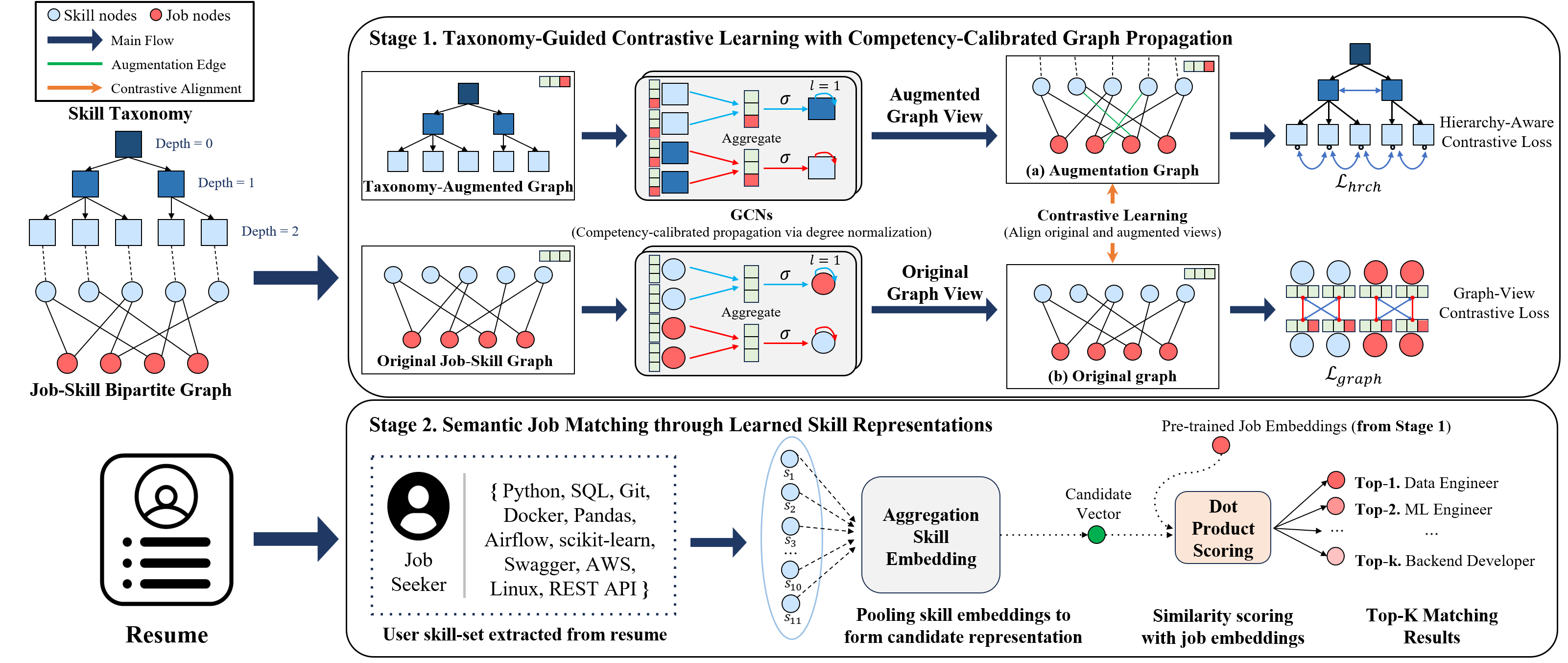
The goal of job-skill matching is to predict appropriate job opportunities for job seekers based on their skill-sets. Prior studies encode unstructured skill data into latent representations using simple mappings within job classification systems. However, such approaches often fall short in capturing the multi-level and asymmetric associations between jobs and job-relevant competencies. To address these limitations, we propose a taxonomy-guided contrastive learning framework with competency-calibrated graph propagation for skill-based job recommendation. The proposed framework combines skill-taxonomy augmentation with degree-normalized bipartite graph propagation, where degree normalization serves as a competency calibration mechanism to mitigate generic skill bias and preserve job-specific competency signals. The model learns both skill and job representations using path/depth cues from the taxonomy and competency-aware interaction patterns in the job-skill graph. Experimental results on real-world datasets show that our method improves accuracy by +13.6%, NDCG@3 by +10.6%, and MRR@3 by +11.7%, outperforming state-of-the-art baselines.
Highlights